



Hugues
-
Posts
942 -
Joined
-
Last visited
Content Type
Profiles
Forums
Events
Articles
Marionette
Store
Posts posted by Hugues
-
-
1 hour ago, jnr said:
Hugues:
Does my profile not show up?
Designer 2019 + 2020, iMac pro on Mojave 10.14.6
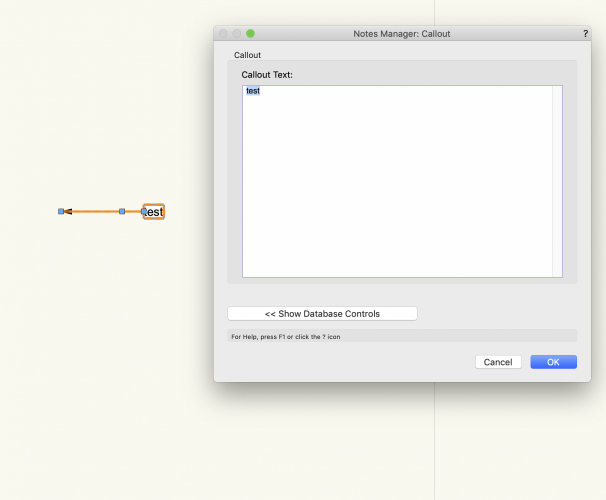
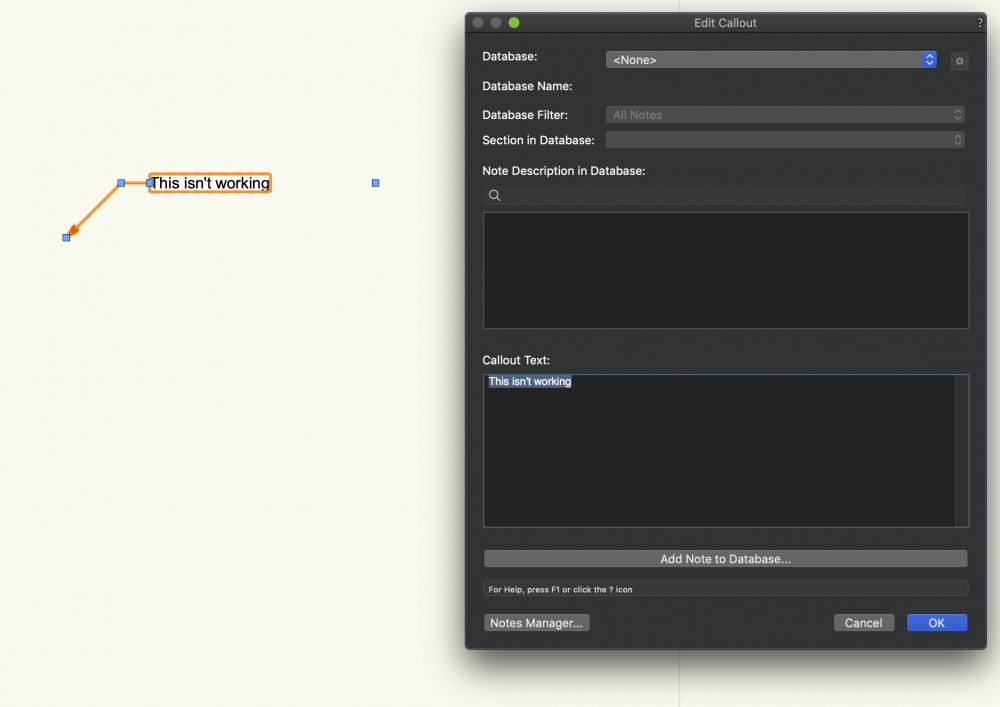
Could you please describe what is happening?
When create a new callout, enter the callout text and click OK, the callout isn't created?
When you edit this callout, enter a new callout text and click OK, the text doesn't change on the callout?
-
@jnr Are you running Vectorworks Fundamentals? Are you on MacOS? Could you share a screenshot of the Callout dialog box or Edit Callout dialog box?
-
@_James You cannot format individual cells or rows in a worksheet database. The formatting in the database always applies to the entire database column.
-
@lgoodkind Could you please clarify the problem? Are you saying that when a file with references is created on one platform, all of the references have to be re-referenced when the file is opened on the opposite platform?
What version of Vectorworks are you using?
-
What do you typically do when you rename them?
Add a prefix? a suffix? Anything else?
-
On 1/17/2019 at 8:03 AM, tca said:
Hi,
Does anyone have a script that allows me to change the name of multiple resources (symbols, walls styles, hatches etc.) at once?
Preferably a search and replace kind of thing that works for all types of resources. Alternatively something that does this for one type of resource at a time.
I have found similar scripts for renaming or pre/suffixing class names...
thanks in advance.
@tca Could you please describe with some examples the types of rename or search/replace operations you are doing?
-
On 8/29/2018 at 9:36 PM, Amorphous said:
(A3) : SLOW WORKSHEET CALCULATIONS
- We run a full BIM model in our office, so everything, including schedules come from our model.
- We find the process of recalcuations to be extremely slow, especially given the records attached to objects are really simple. This surely can be improved.
(B3) WORKSHEET SPEEDING UP
- We can't comment on how your back end works. But the time taken to calculate the simple information we would like to display seems disproportional.
@Amorphous Improving worksheet recalculation speed is on our radar.
Are you recalculating all worksheets in your file? or just a single worksheet? (Note that there are two 'recalculate' commands; one will update all worksheets in your file and the other will just update the active worksheet). Updating all worksheets in your file will be slower of course.
The recalculation speed is proportional to the file size or the number of objects in the file. The nature of the data to be extracted from the objects also determines the performance.
Do you have a typical file that demonstrates slow worksheet calculations? Please send it to me via private message.
Because slowdowns can be caused by many different factors, it is very helpful to us to see many different examples.
-
@Andrew Davies You can change the view settings of the image in the worksheet. Set the standard view to "Top" and the Component to "3D" or "2D Top (and Bottom) cut".
-
@Andrew Davies The issues with your file have been identified. The missing images are caused by incorrect settings on the symbols.
The problem will be fixed.
Thanks,
-
@Andrew Davies could you attach the original 2019 file?
-
12 hours ago, Kevin McAllister said:
Is it intentional that you can't select a group of classes that includes the top level name when your class list is set to display using hierarchical display and assign a tag to them? It works fine when I turn off hierarchical display. I also would have thought I could select a top level name and assign tags to everything within that hierarchy much like I can turn everything with it off or grey it by just selecting the top level name. This is a bit inconsistent with the existing interface.
Kevin
The behavior of the Assign Tags command is consistent with the behavior of other existing menu commands (Edit, Duplicate and Delete).
-
4 minutes ago, rDesign said:
Since they are not Resources, can the Image Effects be applied from one file to another using the Eyedropper tool? Thanks.
Yes.
-
 4
4
-
-
On 5/15/2017 at 3:34 AM, dontevenjoke said:
Thanks for trying.
It's weird. I'm sure no one wants symbols to look like that?
If you are using VW2017, you can change the resolution of the images in the worksheet.
The Image resolution setting can be found in the worksheet preferences dialog (can be accessed from the worksheet File menu).
The default is 150DPI, you would want to increase it.
-
1
-
-
Replacing the class is an option when you replace a symbol from the OIP.
Make sure you have the "Replace class" checkbox unchecked in the "Choose a Symbol" dialog.
-
1
-
-
13 hours ago, Kevin C said:
Does anyone know how to stop the pop-up for "Vectorworks Libraries Update" which pops up every time I start VW. I updated the libraries when it was installed and now every time I start VW - Getting a bit annoying.
It should go away after you hit update.
Do you have many resource libraries in your User an/or Workgroup folder ? When the dialog pop-up again, if you hit update, does the progress dialog shows anything being updated at all ?
-
Markvl,
Open the files in your user libraries in VW2017 and re-save them. This will regenerate all the large previews. Once you have updated all files in your user libraries, run the Refresh Libraries command in the Resource Manager to see the changes; or restart Vectorworks and update your libraries catalog if you get the libraries out-of -date alert.
-
7 hours ago, Mattheng said:
ok, uninstalled and reinstalled.
The Vision error has gone and everything seems pretty normal.
Still achingly slow on the templates, just the ones that I have created but once they are loaded it seems to work ok.
Ah I think I have just sussed why they are so slow...
I have a lot of textures pre loaded in the templates which I probably do not need any more with the new Resource Browser..hmmm...new templates I think I need, as Yoda might say..
Matt
Matt,
High resolution previews have been added for all resources for VW2017. Your templates files have a lot of textures. They are slow because the high resolution previews for the textures are being regenerated for 2017. The Batch Conversion command converts your files but unfortunately it cannot regenerate resource previews. That's why even though you converted your files to the new format, the high-res previews still need to generated when the file is actually opened. This is a one time operation that should only occur the first time you open the file in 2017. Of course, you would need to save the file to keep the previews. The reason you see the slowdown every time you open the template is because your templates are never re-saved. You should open your templates and re-save them.
Hugues
-
1
-
-
1 hour ago, Mattheng said:
Jim,
Here it is.
I have solved the Resource Browser problem, it actually turned out that it had made a translucent copy of all the pallets that had to be deleted...!
I do get this message every time I log in
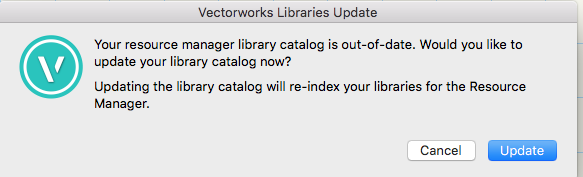
Not sure what it means
It means that the catalog that drives the browsing experience in the resource manager is out of date and must be updated. Click 'Update' in this dialog. You wouldn't have to update again until the content libraries change.
-
Pete, saving a file mostly only involves writing data to disk. The size of the file to be written, the hard drive speed and the network speed (if saving on a network volume) will determine the speed of the operation. Incremental saving is a solution that could definitely improve saving as the amount of data to be written to disk could be significantly reduced. However, the Vectorworks file format doesn't support it yet.
Updating source (referenced) files is a completely different process. It does not involve writing the file to disk at all. When updating a source file, data in the target file that references data from the source file must be updated. Updating these data can be fast or slow depending on the changes made in the source file. For example, if a Wall Style was modified in the source file, all walls in the target file that use this style have to be updated. The number walls and their complexity will determine the speed of the updating process.
Just moving the data from the source to the target file is fast. It is reconciling that data within the target file and regenerating objects that is the expensive step.
If you are experiencing unexpected slowdowns when updating references, please send us a copy of the files and we will be happy to take a look at it (Tech@vectorworks.net). Your files could help us detect a particular configuration or interaction that is not well enough optimized.
-
A Default Story Level is a preset configuration that can be used to quickly set up and create levels when creating stories.
A default story level is like a definition of a level and it must have a level type. You cannot create a default story level with no level type ( level).
What would be the purpose of creating Default Story Levels with no level types ?
-
The .lck file isn't there to prevent other users from opening the file. Its main purpose is to provide the file lock information (user, computer and time of lock). This enables VW to tell you who currently has the file open, where and since when.
It is never used to determine whether another user can open the file. This determination is made by the File System based on the permissions set when the file is opened. The first user to open the file gets READ and WRITE access with READ-ONLY access for other subsequent opens. This is all handled by the File System.
As for DropBox, it uses a push mechanism to keep your local file in synch with the file in the dropbox server.
This means that everyone works on local files in their own local dropbox folders independently from each other.
You are opening your own local file with full permission.
Also note that this issue with dropbox and multiple user environments is common to other applications. This is the nature of the system.
DropBox actually has a a mechanism in place that detects and handles potential conflicts during file synchronization when multiple users had the file opened at the same time.
-
Check for special characters such as : / in the full file path not just the file name.
Are you opening the file using drag&drop on the application icon or double-click in the Finder ?
Could you try opening the file using the Vectorworks File Open menu ?
-
Thanks Matthew, I'll investigate that.
EDIT: this doesn't quite get me there. I guess you can't get there from here.
Click on the New button in the "Edit Marker List" dialog to create a new marker.
You should be able to create any number of new markers of your own based on different root types.
Is there any particular marker geometry that you haven't been able to create ?
Hugues
NV
-
"Please submit a bug report and attach the file(s) so we can investigate."
How do I pass along a file of 92 MB The file works acceptably in VW2012.
If the file is too large, compress it and feel free to use dropbox or www.yousendit.com
Thanks,
Hugues
htsafak@vectorworks.net

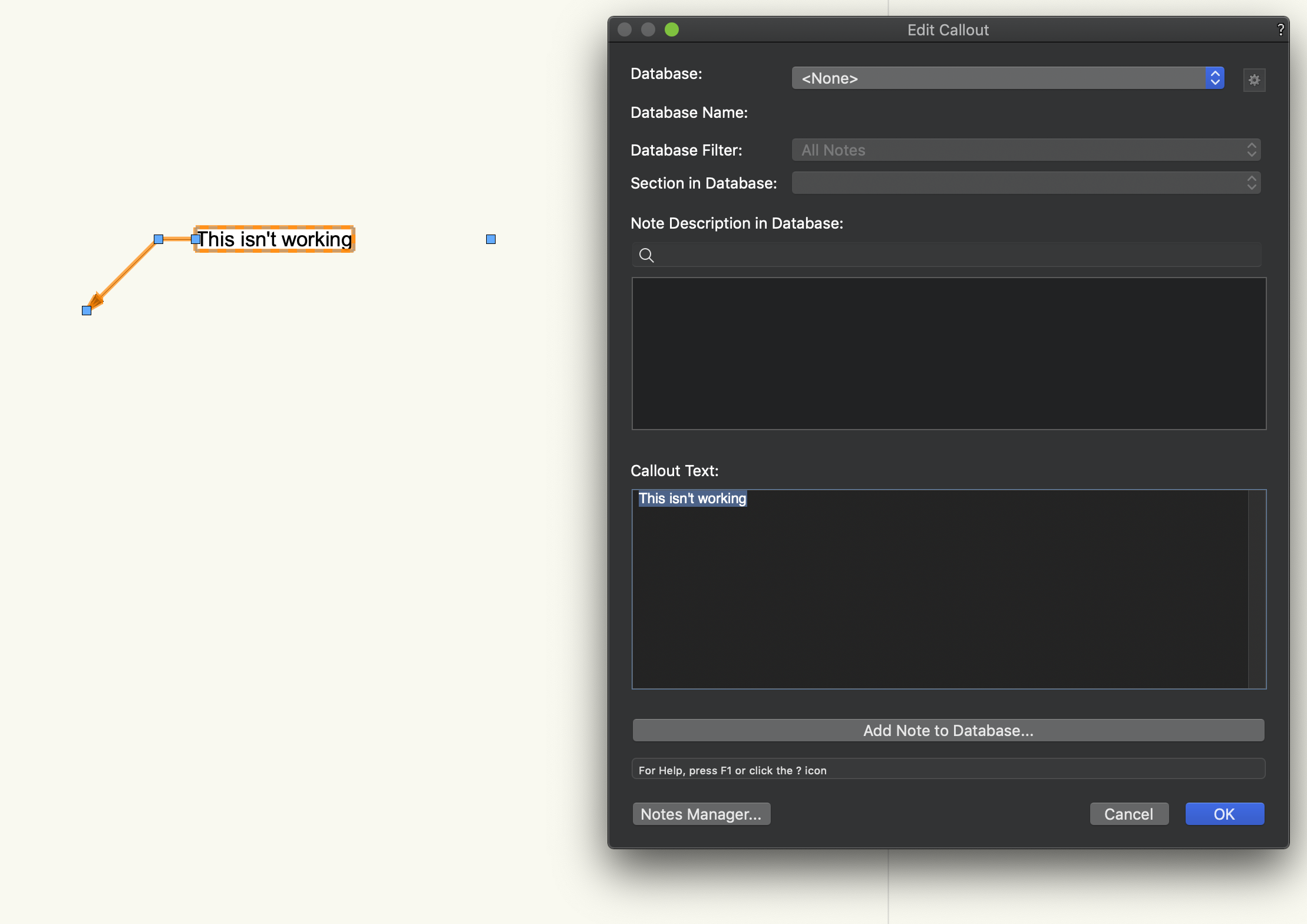
Notes Manager VW2020
in General Discussion
Posted
Yes that is correct. What you are seeing is the new 2020 interface.
If you are not using databases, you can just ignore everything above the Callout text control. These controls are disabled except for the first one, which still allow you to select a database in case you need it, without having to change your preferences.